
Wallowa County Supervision Types
Probation, post-prison supervision, and parole do not mean the same thing in Oregon. Probation is a sentence imposed by a court and served in the community. A judge may include jail as a condition, but probation is not an early release from prison. Post-prison supervision commonly follows a determinate prison sentence for crimes committed after Oregon changed its sentencing system. Parole mainly concerns older indeterminate sentences and other cases within the authority of the Oregon Board of Parole and Post-Prison Supervision.
The label controls where a Wallowa County supervision check begins. The Wallowa Circuit Court record is central for probation. Oregon DOC records and the local community corrections office help confirm post-prison supervision. Board orders matter in Board-controlled parole cases. None of these community statuses means a person remains physically housed in the Union County Correctional Facility. Supervision is a legal status outside the jail, though a violation may lead to renewed custody.
| Status | Who sets it | Best verification source |
|---|---|---|
| Probation | Sentencing court | Wallowa Circuit Court register, judgment, and local Community Corrections |
| Post-prison supervision | Sentence framework administered after DOC custody | Oregon DOC status, judgment, and Wallowa Community Corrections |
| Parole | Oregon Board of Parole and Post-Prison Supervision in eligible cases | Board Action Form or order, plus the local supervising office |
- Discharge
- The end of the supervision or sentence obligation shown by the controlling record.
- Absconder
- A supervised person alleged to have stopped reporting or left supervision without permission.
- Revocation
- A formal action that ends or changes community release after a violation finding.
- Detainer
- A request or hold from another authority that can affect custody or release.
Verify Wallowa County Probation
There is no public Wallowa County list of every person on parole or probation. A reliable check combines the legal record with the office that carries out field supervision. Start with enough identifying facts to avoid a same-name error. A full name, case number, State Identification number, and approximate sentence date are more useful than a name alone. The statewide VISOR service can be a lead because it covers people in custody or under supervision, but it is not a certified supervision record.
- Read the Wallowa Circuit Court register and judgment. Note the exact words used for probation, post-prison supervision, parole, warrant, or discharge.
- Search Oregon Offender Search when a state prison sentence or DOC supervision is possible. Match more than one non-sensitive identifier.
- Check Oregon VISOR for a current custody or supervision lead. Absence may reflect scope, spelling, or full discharge.
- Call Wallowa County Community Corrections and ask which office can verify the status. Do not assume an officer named on the staff page supervises a specific person.
- For a Board-controlled case, obtain the Board Action Form, order, or release-date action. A calendar entry alone proves only that a hearing was scheduled.
- If a violation is suspected, check the court register and ask the Enterprise office about the correct warrant or revocation verification route.
A broader named-person path, including jail, court, DOC, and transfer checks, appears on the Wallowa County released inmate search. Use that route when the type of release is not yet known.
Note: Verify the status label itself, since parole, post-prison supervision, and probation send the same name to different controlling records.
Wallowa County Supervision Office
Wallowa County maintains a local Community Corrections office in Enterprise even though most county prisoners are housed in La Grande. That split matters. Union County is generally the source for a Wallowa prisoner’s jail booking and release line. The Enterprise office is the local route for field supervision after a qualifying release or sentence. The county page says its officers monitor compliance and may report or recommend interventions, sanctions, or termination to the authority that issued the order.
Wallowa County Community Corrections104 W. Greenwood Street
Enterprise, OR 97828
Monday–Friday, 8:00 a.m.–5:00 p.m.
Supervisor line: 541-426-5128
Parole and Probation Officer line: 541-426-5130
Parole and Probation / Work Crew line: 541-426-5129
The official Wallowa Community Corrections page should be checked before calling because staff assignments can change. Ask for the current office or role rather than assuming that a person listed online has a particular case. Agency staff may also limit what they can disclose about an individual.
The Union/Wallowa Community Corrections overview explains the program’s supervision terms. It supports the same basic division: local officers carry out field work, while the court, Board, or DOC retains authority over other parts of the case.
The official Community Corrections program view below shows the shared regional framework.
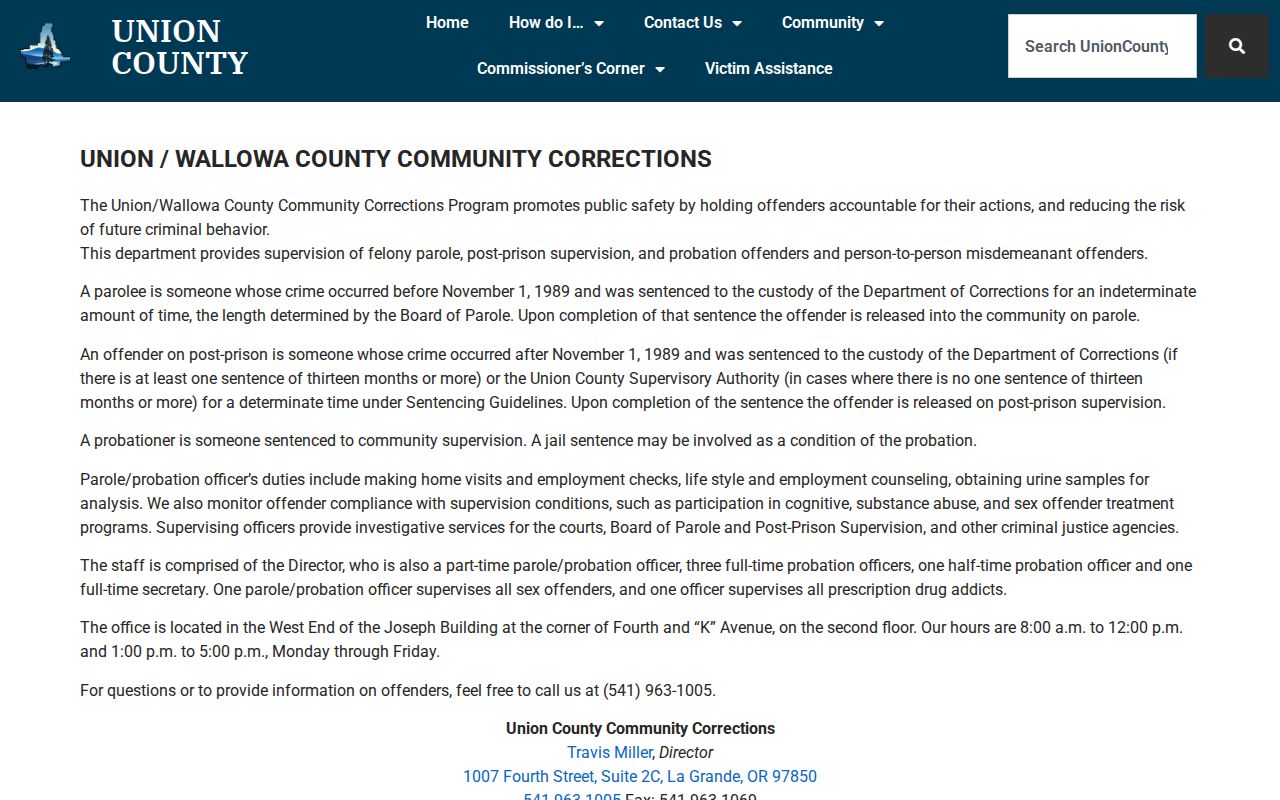
Its definitions help separate a community supervision status from current jail custody.
Wallowa County Parole Hearings
The Oregon Board of Parole and Post-Prison Supervision publishes hearing information and links to monthly, date-specific schedules. Hearing types can include prison-term proceedings, personal reviews, parole consideration, exit interviews, murder reviews, postponements, parole hearings, and future disposition proceedings. Each type answers a different legal question. Depending on the proceeding, an outcome may set, deny, affirm, defer, postpone, rescind, revoke, or order a later release.
A Wallowa County name on a schedule is not proof that parole was granted. Since May 7, 2025, the Board’s notice says hearings occur in person within DOC at Oregon State Penitentiary or Oregon State Correctional Institution, with the notice identifying the institution. Public participation and screening rules apply. Check the official Board Hearings page and current calendar shortly before any planned attendance because schedules can change.
The Board does not provide a simple public search of all parolees or a searchable results database on that page. To verify the result, request the final Board Action Form, order, decision, or release-date action. Give the person’s name, SID, hearing date, and hearing type. The Board reports that most adult-in-custody records are retained for 25 years and most Board records for 10 years, but the responsive record and applicable fee rules still control.
The Board records request route is the official way to seek an order. ORS 144.120 and ORS 144.125 address parts of parole hearings and release review, yet neither supports a universal first-eligible-after-a-fixed-percent shortcut. Crime date, sentence type, judgment, and Board jurisdiction all matter.
Note: A hearing calendar records a planned event, while the signed Board order records the decision that may affect release or supervision.
Wallowa County Absconder Checks
Wallowa Community Corrections has an official page labeled “Most Wanted,” but its content area was empty when the research was completed. That empty page cannot clear a person or confirm that nobody is wanted. It also is not a complete warrant search. A missing name has no evidentiary value when the page supplies no live entries or stated coverage.
Use two direct routes instead. Contact the Enterprise Community Corrections office for the current process, and review the Wallowa Circuit Court register for a warrant, violation, or revocation filing. If the person appears again on the Union County current roster with a parole or probation violation, that can show renewed custody. It does not mean the person remained jailed from the first booking onward.
The official Wallowa absconder page illustrates why a titled web page still needs a content and freshness check.
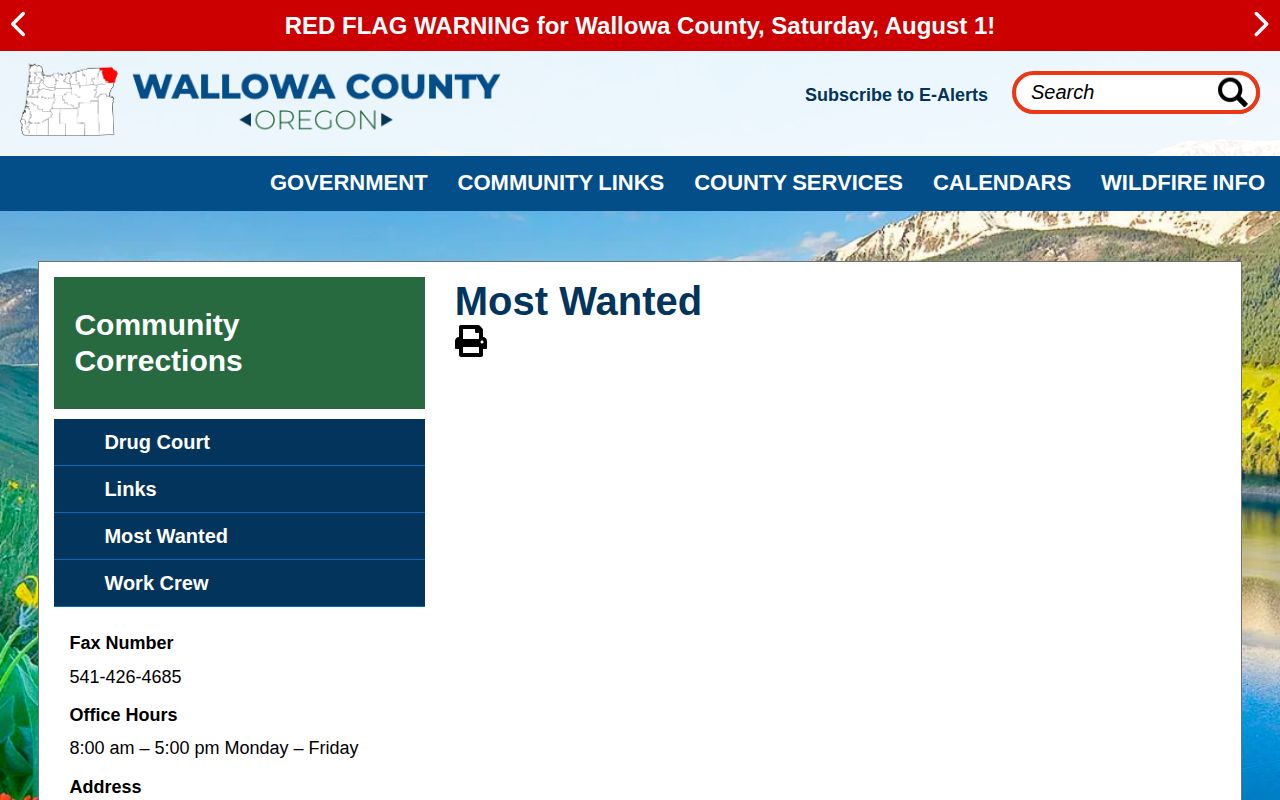
Because the observed page contained no usable list, the office and court record remain the sound verification sources.
Wallowa County Release Alternatives
Wallowa Community Corrections links two local programs that help explain why a community status may not fit a simple jail-or-parole label. Treatment Court is voluntary and combines treatment, court appearances, testing, and graduated responses. Work Crew is an out-of-custody alternative-sentencing structure that can reduce the use of jail beds. Neither program should be treated as proof that a particular person qualifies, completed the program, or has been discharged.
The Wallowa Treatment Court page and Work Crew page describe these local routes. Their value in a supervision check is contextual. A court record may show a community condition or program order that does not appear as a prison release in Oregon OOS. Confirm the person-specific result with the court and local office.
Note: Program participation and formal discharge are separate facts, so use the signed order or agency record for the final status.
Property After Wallowa Release
Property can follow a different custodian from the supervision record. Wallowa Sheriff’s evidence unit says it releases safekeeping property by Tuesday appointment, requires photo identification, and holds that safekeeping property for 30 days. Another person needs notarized authorization. Those rules apply to evidence or safekeeping property held by Wallowa County Sheriff, not to belongings returned during discharge from the Union County jail.
Start with the agency shown on the receipt. The Wallowa Sheriff evidence page covers county-held items. Union County should answer questions about property tied to its jail booking. For a person leaving an Oregon prison, ORS 421.125 separately addresses clothing and documents at discharge. None of these property routes proves that supervision ended.
Wallowa County Supervision Discharge
Supervision ends through the authority and record that control the case. A probation judgment and later court entries may show completion, termination, modification, or revocation. A Board order may show the action in a parole case. Oregon DOC and Community Corrections records can help distinguish release from prison, active post-prison supervision, and final discharge. Do not substitute the end date from one system for the legal status stated by another.
ORS 192.311 through 192.478 provides Oregon’s public-records framework, subject to exemptions and redactions. If the online sources do not settle the question, make a focused request for the discharge, termination, or final supervision record. Name the person, case or SID if known, the supervision type, and the likely date range. Ask for reasonably segregable public material rather than an entire case file.
A final discharge is not the same event as leaving jail. The person may have been in the community for months or years before supervision ended. Conversely, a jail release may have led directly to probation or post-prison supervision. The exact labels in the judgment, Board order, and agency status provide the cleanest answer.